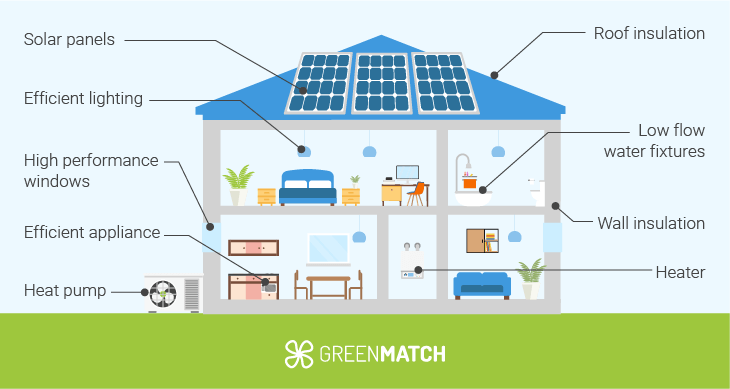
Green energy benefits realized through eco heating are no longer theoretical: rising fuel costs and tightening climate targets have pushed efficient home heating from niche to mainstream. Across the UK and similar markets in 2025, heating represents roughly 64% of household energy use, which concentrates both cost pressure and carbon opportunity in one place. The technical pathway to impact combines building fabric upgrades, low-temperature distribution and smart control with renewable heat sources: heat pumps that deliver 3–4× the energy they consume, hydrogen-ready boilers under trial, solar-coupled hot-water systems, and automated pellet boilers where high-temperature demand persists. Practical deployment follows an incremental, data-driven sequence—tighten the thermal envelope first, size equipment to realistic heat loss, then deploy renewables—so that capital delivers maximal lifetime savings. Field cases from homeowners and integrators such as EcoHeat Solutions and GreenFlow Energy show paybacks that accelerate when grants and low-rate finance are applied. This technical briefing maps the key benefits, system choices, operational trade-offs and immediate actions a homeowner or small contractor can execute to convert heating from a cost center into a decarbonization lever.
En bref : Cut bills: replace inefficient boilers with heat pumps or pellet systems; Cut carbon: move off fossil fuel where feasible; Maximize ROI: insulate and air-seal before upsizing equipment; Use tech: smart controls and storage shift demand to low-carbon periods; Leverage policy: grants and incentives reduce upfront costs. These steps form an ordered program to realize the full green energy benefits of eco heating.
Green energy benefits of eco heating systems: efficiency, emissions and economics
Why prioritize eco heating? The answer is technical and economic: heating dominates domestic energy consumption, so modest efficiency gains propagate large absolute savings. Replacing a decade-old gas boiler with a modern cold-climate heat pump can reduce delivered energy by a factor of three in typical UK housing, translating to lower utility bills and significant CO2 reduction.
Policy support amplifies economics: schemes such as ECO4 and related regional grants reduce installation barriers and improve payback timelines. For practical guidance on policy-aligned upgrades and equipment selection see this comprehensive guide to green heating. Final insight: focus investments where thermodynamic returns are highest—heat loss reduction then renewable heat sources.

Minimizing heat loss first: the data-driven foundation
Start with the building fabric. A continuous thermal boundary created through targeted insulation and air sealing reduces peak heat load and allows low-temperature systems to operate efficiently. Practical diagnostics include a blower-door test and thermal imaging to prioritize interventions.
Contractors who follow a performance-first workflow avoid oversizing equipment. For step-by-step field practices and installer checklists consult the installation tips for eco heating. Insight: a well-weatherized envelope both lowers upfront system cost and improves occupant comfort measurably.
Heat pumps and their role in realizing green energy benefits
Heat pumps are the principal electrification technology for space heating in low-carbon strategies. By extracting ambient thermal energy from air or ground and using a refrigerant cycle, they can output three to four times the energy input under typical conditions.
Choose type by context: Air Source Heat Pumps (ASHPs) are lower-cost and faster to install, while Ground Source Heat Pumps (GSHPs) offer higher and steadier COPs at the expense of civil works. A technical overview of configurations and sizing approaches is available in this air and ground source heat pump overview. Final insight: combine high-performance envelope work with correct pump sizing to unlock the advertised efficiencies.
Pairing heat pumps with solar and storage
Electrification reaches full climate value when coupled with renewable electricity and storage. Solar PV offsets grid electricity used by heat pumps across the year; batteries and thermal stores shift production to match demand peaks.
System designers increasingly simulate seasonal performance to size PV and battery systems against local irradiance and thermal demand. An applied case from a retrofit in northern England showed grid export in summer and 40–60% self-consumption in winter with a small battery. Insight: model seasonal balancing to prevent undersized renewables from undermining emissions goals.
Alternative green heat paths: hydrogen boilers, pellets and hybrid strategies
Hydrogen-ready boilers are undergoing pilots as a low-carbon gaseous fuel pathway. Where hydrogen is available via blended or pure supply, these systems can eliminate CO2 emissions at the point of combustion while retaining conventional distribution.
Where very high emitter temperatures are required, automated pellet boilers provide a renewable-solid-fuel solution with modern, low-particulate combustion. For deployment trade-offs between biomass and electrification see this discussion of renewable pellet and biomass options. Insight: match fuel form to thermal demand and logistics—pellets for high-temperature legacy systems, heat pumps for low-temperature modern envelopes.
Smart controls, IoT and operational optimization
Connected thermostats and AI-driven schedules reduce wasted energy by adapting heating to occupancy patterns and weather forecasts. Integration platforms allow load-shifting to low-carbon periods and coordinate heat pumps, thermal stores and PV.
Field data show smart controls often shave 8–15% from annual heating consumption when tuned correctly. For implementation patterns and control architectures consult guidance on smart heating controls. Insight: smart systems are a multiplier—optimize comfort and reduce runtime without changing hardware.
Choosing systems and a practical roadmap for homeowners and contractors
Decision criteria: building size and heat loss profile, local climate, existing distribution system, fuel logistics, and available incentives. For quantified comparisons and expected energy savings see the energy savings analysis.
Illustrative roadmap used by installers such as EcoHeat Solutions and EcoTherm Innovations: 1) audit and blower-door; 2) targeted envelope works; 3) select heat-generation and control strategy; 4) integrate renewables and storage; 5) measure performance and tune. Insight: a staged program minimizes disruption and maximizes lifetime carbon and cost reduction.
Case study: Alex’s retrofit journey
Alex, a homeowner in a mixed-climate region, lowered annual heating bills by combining attic and wall insulation with a cold-climate ASHP and a modest PV array. The project used installer networks including GreenFlow Energy for commissioning and SustainHeat Technologies for monitoring.
Post-upgrade monitoring showed COPs in the 2.8–3.6 range across the winter and a 35% reduction in delivered fossil fuel energy compared to the prior oil system. Insight: real-world deployments validate modeled returns when envelope work precedes system change.
Market actors, products and service models accelerating adoption
Industry names like NatureWarm Systems, PureGreen Heating, RenewHeat Dynamics, EcoFusion Heating, GreenPulse Energy and EarthSmart Heating represent diverse approaches: manufacturer-led integrated systems, subscription-based heat-as-a-service, and installer ecosystems offering grant facilitation.
Homeowners benefit when vendors bundle performance guarantees, commissioning and monitoring. For further reading on program models and real-world installation pathways see this overview of eco heating advantages. Insight: select providers who deliver measured outcomes, not just equipment.
Immediate actions to capture green energy benefits
Begin with a measured audit, prioritize airtightness and insulation, then evaluate renewable heat systems sized to the reduced heat load. Seek available incentives early to lock favorable financing.
Contact accredited installers, request modeled performance, and require post-installation measurement. For additional technical tips and retrofit sequencing review practical energy savings guidance. Final insight: a disciplined, data-led approach delivers predictable savings and robust decarbonization.