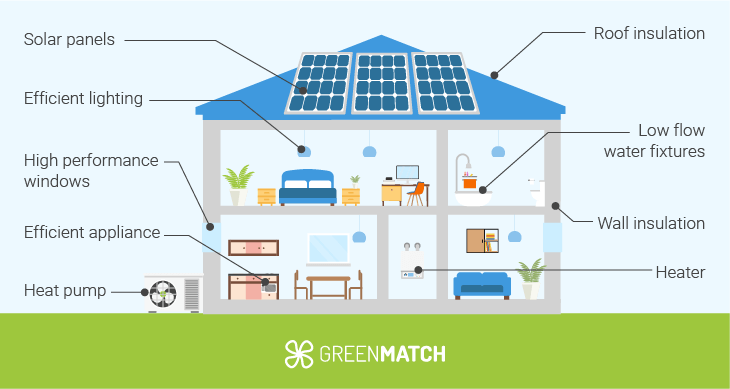
Eco heating system types and their green energy impact examined through a practical retrofit in a mid-size detached home. This technical overview maps seven low-carbon heating solutions, quantifies expected savings and lifecycle implications, and aligns system selection with onsite constraints such as available land, roof orientation and ventilation needs. Homeowners, installers and specifiers will find performance benchmarks, integration pathways with renewable electricity, and realistic cost-to-benefit checkpoints that reflect market and policy signals in 2025.
The narrative follows Maya, a homeowner who commissions a staged upgrade to her 1980s house, and RenewHeat Systems, the installing contractor that models outcomes with monitoring tools. Through this case we compare system efficiencies, operational profiles and maintenance workflows to show how choices such as pairing a heat pump with radiant floors or combining solar thermal with heat recovery ventilation change both running costs and emissions. The treatment focuses on measurable outcomes rather than abstract claims, and it flags key decision triggers: site footprint, fuel logistics, up-front capital and available incentives.
In brief: Geothermal heat pumps deliver the highest coefficient of performance for steady loads; solar thermal reduces domestic hot water demand; biomass is local-fuel dependent but low-carbon when sourced sustainably; pellet stoves offer low-maintenance zonal heat; radiant floor maximises comfort at lower supply temperatures; HRV preserves heat while improving IAQ; passive solar design cuts peak heating needs. See practical installation notes and system comparisons below to align technology selection with site constraints.
Geothermal heat pumps: efficiency metrics, land impact and lifecycle case
Problem: Maya’s house has high winter heating demand and a constrained budget for monthly bills. Ground-source heat pumps answer the operational cost problem by leveraging stable ground temperatures to achieve high efficiencies.
Solution: A borehole-loop geothermal installation paired with a low-temperature distribution system (radiant floors) delivers annual seasonal performance factors often between 3.5 and 4.0, meaning up to 400% system efficiency under optimal conditions. Installers must weigh drilling costs, ground conductivity surveys and loop-field layout against long-term electricity prices.
Example: RenewHeat Systems modelled Maya’s property and selected vertical boreholes due to limited horizontal space; predicted payback came from utility bill reductions and a 2025 heat-pump rebate. For technical guidance on site assessment and installation sequencing consult the practical installation guidance.
Insight: Where land is scarce, vertical arrays reduce footprint but increase installation cost; the decisive metric is lifetime cost per kWh of useful heat.
Integration with smart controls and PV
Problem: Matching heat pump operation to variable-grid renewable generation is non-trivial. Without coordination, heat pumps can increase peak demand.
Solution: Use smart thermostats and demand-shifting logic that prioritise times of high on-site PV or low tariff periods. These control strategies are described in detail at smart control best practices.
Example: Maya set her system to pre-heat floors during midday PV surplus, lowering evening grid draw and improving effective system COP. The insight: smart scheduling can change economic outcomes as much as hardware selection.
Solar thermal systems: collector types, yield profiling and practical limits
Problem: Domestic hot water is a significant share of household energy and often overlooked in retrofits. Standard heat pumps address space heating well but combining with solar thermal reduces auxiliary energy for hot water.
Solution: Flat-plate and evacuated-tube collectors capture solar radiation and transfer heat to a store via heat exchangers. Active systems use pumps and controls for higher yield; passive thermosiphon setups are simpler but less controllable.
Example: On Maya’s south-facing roof, an evacuated-tube array with a 300–500 L thermal store covered a large portion of DHW demand seasonally. For guidance on pairing solar thermal with existing heating circuits see the overview on renewable energy sources.
Insight: Solar thermal delivers greatest value where DHW load is predictable and storage can be sized to match solar availability; combining with heat pump backup reduces the hybrid system’s carbon intensity.
Design points and maintenance
Problem: Thermal stores and glycol loops can fail if not sized or protected against freeze and stagnation.
Solution: Oversizing collectors without matching store capacity increases stagnation risk. Integrate temperature sensors and a differential controller; plan for periodic checks of antifreeze concentration and pump integrity.
Example: The contractor scheduled annual checks and linked alerts to Maya’s mobile app. The operational insight: routine monitoring extends life and preserves expected savings.
Biomass boilers and pellet systems: fuel logistics, emissions and efficiency
Problem: Biomass promises carbon neutrality only when supply chains are managed; poor-quality fuel or intermittent supply erodes benefits.
Solution: Modern biomass boilers and automated pellet systems reach thermal efficiencies around 90% when fed with certified fuel and maintained to OEM schedules. Fuel storage planning and supply contracts are critical technical specifications.
Example: Maya considered a small biomass boiler but decided on a pellet stove insert for zonal heat due to delivery constraints and limited storage. For comparative system specs consult system typology and specs.
Insight: Biomass is viable in rural contexts with stable, local supply chains; urban projects should prioritise low-emission pellet systems with filtration to control PM.
Operational protocols and emissions control
Problem: Incomplete combustion increases particulate emissions and reduces efficiency.
Solution: Install secondary air systems, automated feed control and certified flue filtration. Combine with smart metering to detect deviations from expected burn profiles.
Example: The installer provided a fuel quality checklist and seasonal maintenance plan for Maya. Final insight: performance depends on both equipment specification and disciplined fuel management.
Pellet stoves, radiant floor heating and HRV: zoning, comfort and IAQ
Problem: Balancing user comfort, distribution losses and indoor air quality requires a combination of technologies rather than a single fix.
Solution: Use pellet stoves for zonal backup, radiant floors for whole-house low-temperature heating, and heat recovery ventilation (HRV) to maintain air quality while preserving heat. HRV units can reclaim up to 85% of exhaust heat, reducing net load on the main system.
Example: In Maya’s living area a pellet insert provided reliable evening warmth, while hydronic radiant floors supplied background heat. An HRV unit maintained balanced ventilation and filtered outdoor pollutants, an approach outlined in the efficiency studies at projected energy savings.
Insight: A layered approach—zonal plus whole-house distribution plus ventilation—delivers the best trade-off between comfort and efficiency.
Technical design for radiant and HRV
Problem: Installing radiant floors in existing builds can be disruptive and costly if not planned with distribution and control in mind.
Solution: Choose hydronic loops sized for low temperature operation and pair with modulating boilers or heat pumps. For HRV, select units with low fan power and high sensible recovery and design ductwork to minimise pressure losses.
Example: The retrofit used a thin-slab hydronic retrofit system in upstairs bathrooms and matched flow temperatures to the heat pump curve. Insight: correct hydraulic balancing is the decisive factor for even heat delivery.
Passive solar design and envelope improvements: reducing demand before adding supply
Problem: Adding new heating capacity without addressing envelope losses wastes capital and energy. Passive measures reduce the baseline load and improve system economics.
Solution: Re-orient glazed surfaces, increase thermal mass where appropriate, use external shading to avoid summer overheating, and upgrade insulation and window performance. These steps lower peak heat loads and improve the effective COP of active systems.
Example: Maya reconfigured a south-facing extension with high thermal mass flooring and operable shading. The combined effect reduced her design day heat load by a measurable margin, a planning approach supported in the sustainable living guidance at sustainable retrofit guidance.
Insight: Demand reduction is always the highest-return investment; smaller active systems cost less and run more efficiently.
Policy, incentives and selecting a vendor
Problem: Incentive landscapes and vendor claims complicate procurement.
Solution: Validate installer credentials, request monitored performance guarantees and check eligibility for 2025 rebates or tax credits. Use independent carbon accounting to compare options; see the carbon analysis resource at carbon footprint analysis.
Example: EcoHeat Solutions, GreenTherm Systems and SustainHeat Technologies were among suppliers that provided lifecycle models for Maya; she selected a team that also integrated EcoEnergy Heating controls and a complementary GreenWave Heat pellet insert. Final insight: choose partners who quantify outcomes, not just equipment.
Operational optimisation and smart integration for lifecycle gains
Problem: Installed systems underperform when controls and user behaviour are not aligned.
Solution: Integrate smart thermostats, grid-aware controls and performance monitoring. Systems from vendors such as PureHeat Innovations, EcoTherm Green and GreenPulse Heat increasingly provide API access for energy management platforms, enabling automated demand response and better long-term performance.
Example: Maya adopted a smart schedule that used midday PV, pre-heat windows and reduced overnight setpoints; her monitored data showed lower bills and smoother temperature profiles. For control strategies and analytics see the resource on smart thermostat controls and integration techniques at system-level energy-efficiency methods.
Insight: The marginal cost of adding intelligence is small compared to lifecycle savings; smart controls turn efficiency into realised savings.
Choosing among brands and next steps
Problem: Market noise and promotional claims make comparison difficult for non-technical owners.
Solution: Evaluate on consistent metrics: delivered kWh of heat per year, installed cost per kW, maintenance schedule, and verified emissions per unit of useful heat. Compare proposals alongside monitored case studies and independent reviews.
Example: After two years Maya’s integrated solution—ground-source heat pump, solar thermal preheat, HRV and zonal pellet backup—reduced her annual heating-related emissions by over 60% versus a baseline oil boiler. Suppliers like RenewHeat Systems and EcoFlow Heating provided post-installation monitoring to validate results.
Insight: Prioritise measurable performance, transparent warranties and an operations plan; these determine whether theoretical efficiencies translate to real-world decarbonisation.