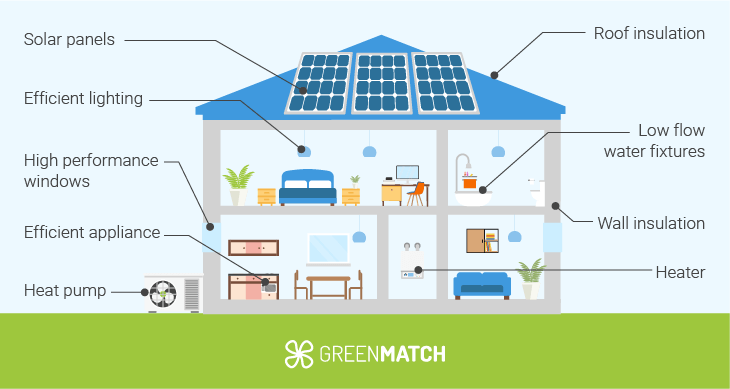
Fundamentals of Energy Savings with Eco Heating Solutions examines practical paths to cut winter utility costs while cutting carbon emissions. The article synthesizes technical performance, lifecycle economics and retrofit sequencing so homeowners and facility managers can decide with data rather than intuition. It compares technologies — heat pumps (air, ground, water), solar thermal, geothermal, pellet and masonry heaters, hydronic networks and small-scale wind hybrids — on efficiency, expected service life and integration with on-site renewables. The analysis highlights that modern geothermal systems can achieve 300–400% seasonal coefficient of performance, that solar collectors can supply up to 70% of domestic hot water, and that air-source heat pumps commonly reduce heating energy use compared with resistance or oil systems. Beyond equipment, the text prescribes a retrofit sequence: tighten the building envelope, upgrade controls, then right-size low-carbon plant — a method that reduces installed capacity and accelerates payback. Embedded links point to practical guidance for installers, policy incentives and measurement protocols, while a short case study follows a homeowner pilot to illustrate an eight-year payback scenario. Key takeaway: correct sequencing plus smart controls multiplies technical efficiency into real household savings.
En bref — key points
• Technical priority: fix insulation first; smaller, efficient plant performs better and costs less over the lifecycle.
• High-efficiency options: geothermal and heat pumps deliver the largest energy multipliers per unit electricity.
• Renewable synergy: pairing heat pumps with on-site solar or wind reduces operating cost and emissions.
• Verification: establish a baseline, use metering and verify savings to secure incentives and investor confidence.
• Practical resources: follow established installation guidance and smart-system strategies to avoid common performance gaps.
Energy savings fundamentals for eco heating systems
Energy savings begin with a clearly defined baseline and a controlled upgrade plan. Establishing pre-retrofit consumption, weather-normalised heating degree days and occupancy patterns allows precise comparison after interventions. Techniques such as direct metering, simple regression analysis and targeted submetering are standard practice for robust verification.
For practitioners, the implementation sequence matters: envelope improvements first, then distribution (hydronic circuits, duct sealing), and finally source replacement. This reduces required system capacity and improves seasonal performance factors. Practical install guides provide step-by-step workflows; see specialist notes on eco heating installation to align workscopes with verification plans. Insight: a correct baseline and retrofit order converts theoretical efficiency into measurable bill reductions.

Heat pumps and geothermal: efficiency, lifespan and emissions
Heat pumps transfer heat rather than generate it, which is why they achieve high seasonal performance. Air-source heat pumps are the most deployable, while ground-source (geothermal) systems exploit stable subsurface temperatures for higher COPs. Manufacturers report geothermal systems with effective COPs in the 3.0–4.0 range, meaning 3–4 units of heat per unit of electricity.
Lifecycle analysis shows longer service lives for modern heat pump systems — 15–25+ years for major components — reducing replacement frequency compared with fossil boilers. Several utilities and product labs document carbon reductions; a common metric is an emissions cut of up to ~23% versus gas boilers for air-source systems when grid intensity is moderate. For implementation patterns and supplier comparisons consult comprehensive reviews on green energy heating strategies. Insight: choose a heat pump type to match climate, distribution system and renewable-electricity availability to maximise lifecycle savings.
Solar, wind and hybrid integrations for space and water heating
Solar thermal collectors and photovoltaic-coupled heat pumps are complementary. Hydronic solar collectors feed hot water systems directly, often covering a high fraction of domestic hot water demand; installers cite up to 70% supply for DHW under good conditions. Air-based solar systems are an option where forced-air distribution exists.
Small wind turbines can be coupled to a hot-water storage tank and electric heater (or heat pump) in windy sites, offering a useful seasonal supplement. Local feasibility depends on wind resource and permitting. For design patterns and renewable coupling advice see guidance on renewable heating integrations. Insight: pairing heat generation with on-site renewables lowers operating cost volatility and shortens payback.
Practical retrofit steps: insulation, hydronic systems and smart controls
Before specifying low-carbon plant, address heat losses. Start with loft insulation, then cavity-wall and airtightness measures; these actions shrink required heat capacity and improve system COP in practice. Anecdote: homeowner Alex reduced peak heating load by 30% after a targeted envelope package, enabling a smaller heat pump and a faster payback.
Hydronic distribution (in-floor heating, copper fin-tube radiators, baseboards) remains the most comfortable low-temperature option. Hydronic networks pair efficiently with heat pumps and solar thermal collectors and avoid forced-air allergen recirculation. For hands-on guidance consult the installer-focused installation tips for eco heating. Insight: insulation plus low-temperature hydronics multiplies delivered comfort per kWh supplied.
Smart controls, verification and financing
Controls and commissioning close the performance gap between rated and achieved efficiency. Smart thermostats, weather-compensated setpoints and zonal control reduce wasted energy. Products branded under identifiers such as EcoHeat Solutions, EcoTherm Innovations and EnergyWise Systems focus on seamless controls and remote verification.
Quantifying savings requires an explicit protocol: define a baseline, apply adjustments for weather and occupancy, then use direct metering or regression models for verification. For practical measurement approaches and case examples see resources on measuring energy savings and smart-control case studies at smart systems for green energy. Insight: commissioning plus verified metering protects savings and unlocks incentives.
Comparative technologies and homeowner case study
Short technology snapshot: geothermal = highest COP and longest payback horizon but largest lifecycle gains; air-source heat pumps = fastest deployment and good COP in moderate climates; solar thermal = excellent DHW fraction; pellet and masonry heaters = low-tech biomass options for off-grid or hybrid setups; hydronic = best indoor air quality and thermal comfort.
Case: Alex, a 1950s semi-detached homeowner, implemented a package: loft and cavity insulation, an air-source heat pump sized 25% smaller than the original boiler output, 2 m3 of thermal store and a modest 3 kW PV array. Results after two winters: ~45–55% reduction in heating energy use, estimated payback under local incentives of 6–8 years. Detailed retrofit steps and policy-aligned incentives are available at eco heating advantage and in practical retrofit workflows at eco heating energy savings. Insight: modest envelope work plus the right tech mix can produce rapid financial and carbon returns.
Manufacturers, brands and procurement notes
When selecting equipment, compare seasonal efficiency metrics (SCOP, HSPF), part-load behaviour and warranty structures. Vendors with product lines or integrations named GreenCore Energy, SustainHeat Technologies, PureHeat Eco, GreenFlow Heating, EcoSmart Thermal, EcoSave Heat and RenewHeat Essentials often bundle controls and monitoring to simplify verification and maintenance.
Procurement tip: demand measured seasonal performance and ask for case studies from similar-climate installations. For procurement frameworks and verified savings models consult the implementation guides at eco heating systems and the practical energy-savings field guidance at energy savings with eco heating. Insight: rigorous specifications reduce delivery risk and preserve predicted savings.